February 11, 2012
FFF Results Post #282—Name Your Ending
On Friday,
CR readers were asked to "Name Four Endings In Comics That Weren't Really Endings But You Thought Would Have Worked; Explain One Of Your Choices." This is how they responded.
 Tom Spurgeon
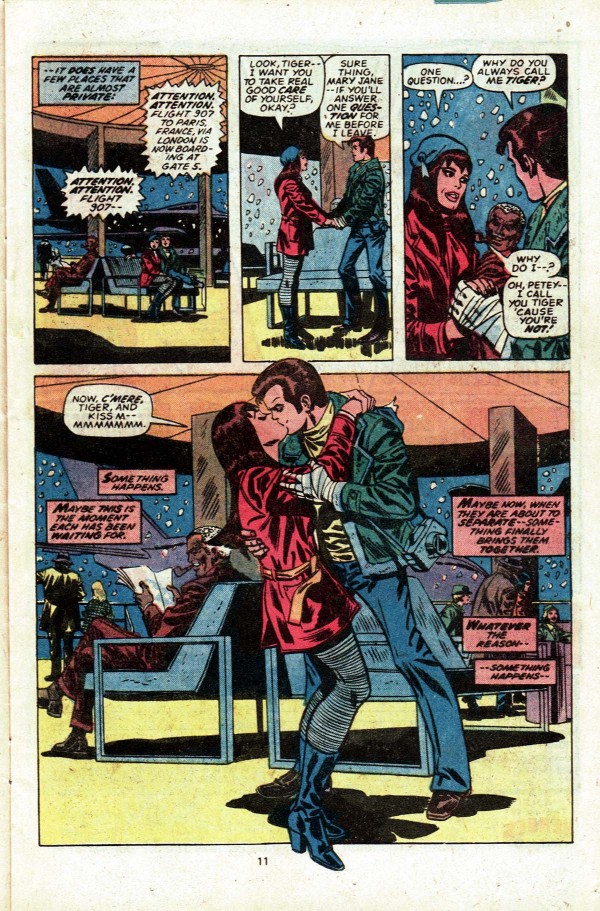
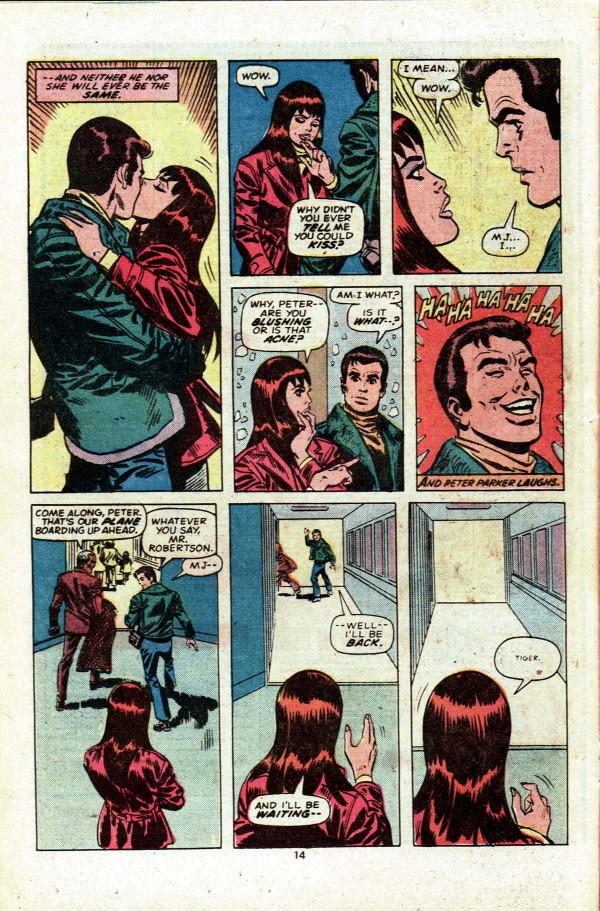
1. Pages 13-14 in
Amazing Spider-Man #143.
2.
Cerebus #150
3. The last Milton Caniff
Terry And The Pirates
4.
Nexus #50
5. These two pages from a post-Ditko, post-Romita
Amazing Spider-Man issue always struck me as an appropriate ending for the character's story because after years of suffering through the character of Peter Parker making every effort to become an adult and to embrace what he perceived as the greater responsibilities of that state, this showed him finally making one of the most adult choices of all: to be happy.
*****
 Andrew Mansell
1.
Master of Kung Fu #118
2.
Marvel Two in One Annual #2
3.
Superman #423/
Action #583
4.
Uncanny X-Men #200
5. The perfect ending to a very smart and groundbreaking series with Shang Chi telling Sir Denis he loves him (as a father) A beautiful, perfect ending--instead we get a limpid comic coda, a defecting writer, the passing of a terrific artist all casualties of the Shooter regime.
*****
 Marty Yohn
1.
Swamp Thing (vol. 2) #64
2.
Jonah Hex (vol. 1) #53
3.
Claw the Unconquered #12
4.
Fantastic Four #200 (Dr. Doom's s character)
5. I thought Alan Moore's swan song on the title after some 40+ issues was the perfect ending for Abby and Alec's love story. As they slipped into the swamp at issue's end, Moore had tied up a number of loose ends perfectly, and considering the weirdness that was to follow under other creators, I've always felt this was where my interest in the character ended.
*****
 Dave Knott
*
The Castafiore Emerald
*
The Immortal Iron Fist #16
* The
Robotman/
Monty strip where Robotman leaves Earth (and his own comic) forever
*
Grendel #40
* After many globe-trotting exploits culminating in possibly his greatest adventure in Tibet, Tintin takes a break and engages in some at-home comedic drama. This would have been a fine place to finish things off, Tintin & co. finally settling down and living thge life of Riley, with only the occasional domestic mystery to solve.
*****
 Kumar Sivasubramanian
1.
Swamp Thing #64, Alan Moore's last story
2.
Miracleman #16, Alan Moore's last story
3.
Whatever Happened to the Man of Tomorrow?, Alan Moore's last Superman story
4.
DR & Quinch, Alan Moore's last story
5. I can kind of understand how the first three carried on, and I realize the end of
DR & Quinch was not necessarily an ending at all, but really bringing it back with Jamie Delano writing it was just some kind of exercise.
*****
 Justin Colussy-Estes
1.
Dark Knight Returns
2.
Secret Wars
3. The last Jerry Scott
Nancy strips
4. Every Valiant book after Jim Shooter was fired/Bob Layton took over/Unity
5. I know having someone follow a beloved creator on a legacy strip reeks of creative and corporate grave robbing, but I thought what Jerry Scott did was interesting: he took one of the most iconic strips of the century and made it his own, so
Nancy wasn't the exercise in reminding everyone how far short of Bushmiller the artist falls (like it seems to be today), but instead had a liveliness and humor that stood outside of Bushmiller's long shadow.
*****
 Buzz Dixon
1.
The Adventures Of Barry Ween: Gorilla Warfare
2.
Cerebus #231 (end of
Rick's Story gn)
3. Ming last seen faking a coma in Alex Raymond's
Flash Gordon
4.
Goofyfoot Gurl #4
5. Micahel Jantze's comic strip
The Norm used the conceit of Norm being able to summon up and interact with himself at previous stages of his life: A child, a teenager, a college student, etc., seeking feedback and advice from them on current situations in his life. Jantze ended the print version of the strip with Norm discovering he was about to become a father. Norm stumbled from his house, overwhelmed by the news, not knowing if he was capable of such a responsibility. His younger selves appeared, but then so did a slightly older version of himself: Dad Norm. Dad Norm thanked Norm for doing a good job up to that point, but it was now his turn to take over. He went into a house to assume the responsibilities of being a father, freeing Norm to hang out with his younger selves, always the happy newlywed.
*****
 Marc Mason
1.
Daredevil #233
2.
Walking Dead #6
3.
Secret Wars #12
4.
Hellboy: The Conqueror Worm
5. The "Born Again" storyline allowed Frank Miller to finish Matt Murdock's story completely. By the time it was over, he had found true love, discovered his mother, and delivered a crushing defeat to his greatest foe. The character was now a man in full, and he didn't really need to be a costumed adventurer anymore. While some fine work has been done with the character in the intervening years, had we never seen him again, that would have been okay. The tale had reached its end.
*****
 Bryan Munn
1.
Tintin in Tibet
2.
Superman: Whatever Happened to the Man of Tomorrow?
3.
Ed the Happy Clown, first ending/first collection
4.
L&R 50 (conclusion of
Bob Richardson, Maggie-Hopey reunion)
5. While the next book in the series,
The Castafiore Emerald, is a masterpiece,
Tintin in Tibet, with its bare-bones reunion plot and simple beauty, and that capper image of the Yeti silently watching Tintin, Haddock and Chang head back down the mountain, is a perfect ending for the series. Herge was at the peak of his powers here and seems to have essentially lost interest in the series in its classic form after Tibet.
*****
 Tom Bondurant
1.
New Teen Titans vol. 2 #31
2. Barry Allen's death (in
Crisis On Infinite Earths #8)
3.
The Hunger Dogs graphic novel
4.
Doom Patrol vol. 2 #63 (Grant Morrison's last issue)
5.
NTT #31 was the end of a big-blowout storyline which tied together subplots for just about every character -- some going back six years -- and also literally put out to pasture Brother Blood, one of the series' most persistent villains. It also returned Raven to active duty (she'd been lost after being purged of her dark side) and sent Wally West off to his new solo Flash series. For such a plot-intensive series, this was quite an achievement, and the Titans could thereafter have retired in peace.
*****
 Michael Grabowski
1. 10/28 & 10/29 1988 panels for
The Far Side
2.
Cerebus #265
3.
Bob Richardson (conclusion),
Love & Rockets Vol. 1 #50
4. "Chelo's Burden,"
Love & Rockets Vol. 1 #50
5. By the time Gary Larson took that year+ hiatus, I think he had played out all the running themes he applied. When he returned, the panels seemed to offer only more of the same which is to say less than one might have hoped. (Compare to the growth in
Doonesbury and
Calvin & Hobbes following their creators' respective initial hiati.) I don't think any of the 1990-1995 panels, while still frequently entertaining, sustain the same sort of glorious surprise that Larson's earlier years provided with remarkable consistency. The panels above were his last two before the pause, and they do a nice job of self-reflection and acknowledgement of his art's themes and limitations.
*****
 Marc Sobel
1.
Love & Rockets #50
2.
Swamp Thing #64
3.
Animal Man #26
4.
Fables #75
5.
Fables spent a full 75 issues building the drama toward a climactic battle which culminated in issue #75. It was a very satisfying ending to a story more than six years in the making, but afterward, everything felt like denouement.
*****
 Rodrigo Baeza
1. Prince Valiant marries Aleta (Spoiler alert!)
2.
Marvel Two-in-One Annual #2
3.
El Eternauta (1957-1959)
4.
Asterix in Belgium
5. The original version of
El Eternauta, by Héctor Germán Oesterheld and Francisco Solano López, was serialized in weekly installments between 1957 and 1959. It didn't take long for sequels to appear, first by Oesterheld (in prose stories in the early 1960's, plus an official second part in the mid-1970's that was drawn by López), and later by other hands. But even taking into account that the original writer was responsible for the initial sequels, the original comic is to me the definitive version, the one that stands as a supreme achievement in Spanish-language comics, and that has an ending more satisfying than any of the stories that followed.
*****
 Chad Nevett
1.
Dreadstar #31
2.
The Authority #22
3.
Transmetropolitan #24
4.
Adventures of Superman #623
5. The Authority, having become bloated and corrupt in their own way are killed by the governments they pissed off and replaced with a group that will cater to the Powers that Be. That always seemed like an appropriate and fitting ending for the book that pushed the boundaries a little and had its share of controversies and would, eventually, die a death of slow mediocrity.
*****
 Sean Kleefeld
1.
Marvel Super Heroes Secret Wars #12
2.
Persepolis vol. 1
3. The penultimate full-color
Little Nemo in Slumberland strip
4.
The Sentry vol. 1 #5
5. For as fascinating and engaging as
Persepolis volume 1 was, I thought volume 2 was terribly self-absorbed and off-putting. Having the story end with Marjane leaving on a plane to a better life in Austria at the end of volume 1 would have resulted in a similar tonal ending, but without all the trivial, ego-centric teen angst that fills volume 2. I know people like to hold the two books up as a great work, but the second volume paints Marjane as an annoying, whiney teenager, who ultimately destroyed any empathy that I developed for her in volume 1.
*****
 Adrian Kinnaird
1.
The Ultimates 2
2.
Daredevil #233
3.
New X-Men
4.
Green Arrow #75
5. This was near the end of Grell's 'mature readers' run on the book; pretty much all of Ollie's 'chickens come home to roost' in the series. He has to deal with ex-ward Roy Harper (brainwashed into almost killing him), Shado and their illegitimate son, and finally Diana, who catches Ollie fooling around with Marianne (a maid marian stand-in) at a New Year's Eve party. She comes to the realization that after everything they've been through together (post traumatic stress, Ollie's refusal to marry her or have a child with her) he's shared more of himself with everyone else in his life but her. At the end of the issue she leaves him for good, sitting alone in the snow. It would have been a perfectly devastating (and inevitable) conclusion to Grell's series.
*****
 Matt Emery
1.
Charley's War at the point Pat Mills stopped writing it.
2.
Fables #75
3.
The Uncanny X-Men #200
4.
Asterix in Belgium
5. Sam Slades Last Case in
Robo-Hunter --
2000AD prog 331-334. Perfect point to end
Robo-Hunter. He's old and forced back into the game after his robots have spent all his money, bringing him back to where he was when the serial started in 1978.
*****
 Mark Coale
1.
Animal Man 26
2.
FF 50
3.
Captain America 175
4.
Brave and Bold 200
5. One of the things I love most about Morrison's
Animal Man run is that after all the trauma he put Buddy Baker through for two years, he put all the pieces back in the toy box for the next creator. But it also makes it feel like a finite, self-contained story.
*****
 Bart Beaty
* Maggie and Hopey sitting in the police cruiser at the end of
L&R v1
*
Asterix in Belgium
*
Shade the Changing Man #50
*
Miracleman #16
*
Zot #35. For some reason, I never saw
Zot #36 when it was being published. I just thought that the series ended (beautifully) when they disappeared into the box. When I first met Scott McCloud he said something about
Zot #36 and I thought he was joking. In fact, I think I even argued with him about how many issues there were! When I finally read the last issue I thought it was good, but I still liked my own ending better.
*****
okay, the art on this one was hard; I did my best
*****
*****
posted 11:00 pm PST |
Permalink
Daily Blog Archives
November 2019
October 2019
September 2019
August 2019
July 2019
Full Archives