Home > Bart Beaty's Conversational Euro-Comics
L’Elite a la portee du tous, Etienne Lecroart
posted January 20, 2006
Home > Bart Beaty's Conversational Euro-Comics
L’Elite a la portee du tous, Etienne Lecroart
posted January 20, 2006
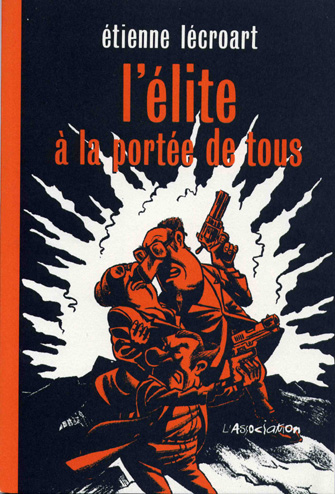
Few cartoonists have kicked at the formal boundaries of the comics medium as repeatedly as Etienne Lecroart. His OuBaPo-inspired books for L'Association and Seuil have repeatedly pushed the limits in new and intriguing ways.
Cercle Vicieux (L'Association, 2000) is a palindromic comic, reading exactly the same forward and backward.
Le Cycle (L'Association, 2003) is a scientific investigation of the status of the comic book panel by scientists operating within those panels.
Ratatouille (Seuil, 2000), tells the same intersecting story from a number of directions. Now he's back to test the comics form once again.
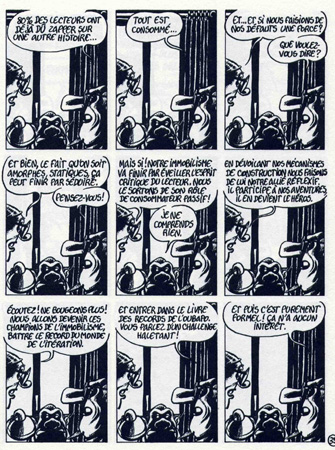
L'Elite a la portee de tous (L'Association) is Lecroart's commentary on genre. Here, his three comic book scientists again face a challenge to their conception of reality when they learn that they are dull. Like the heroes of so many small-press comics, nothing really happens to them. When one of the three disappears unexpectedly, they can barely muster any enthusiasm for such a weak plot device. The problem, it seems, may be stylistic. Lecroart draws in a cartoony big-nose style that is not appropriate for intrigue and high tension. So the characters don new bodies, taking on forms associated with the classic French realism of the best-selling adventure series. Immediately, Mlle. Anne is recruited to be the new star of Van Hamme's
Largo Winch series, and the fame goes to her head. When things devolve in an erotic fiction, the scientists realize that realism has taken them down a misguided path. They set off to find new genres of storytelling. A trip to Japan leads to their manga-fication, and when that too goes awry, they settle into a boringly unvarying panel layout, hoping to return to some sense of stability.
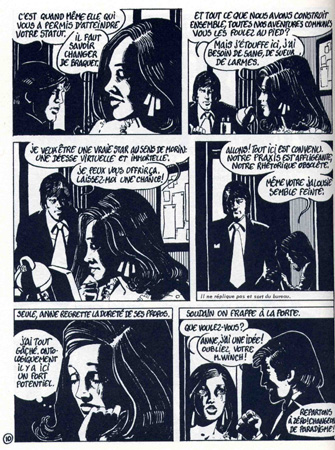
Lecroart cycles through genres here in a witty way. Few artists would push the conclusions that he draws as aggressively as he does here. The classic French characters meet the manga style is all the rage now (as in the new
Asterix book, or Baudoin's
Crazyman) but only Lecroart has his characters addressing the difficulties that arise when a left-to-right oriented hero meets a right-to-left oriented one. And only Lecroart would fill a sex scene with a discussion of the aesthetics of pornography and references to Robbe-Grillet. Simply put, his work is ten times smarter than that of his contemporaries who are exploring similar issues.
Nonetheless,
L'Elite a la portee de tous is not a true success. In comparison to
Le Cycle and
Circle Vicieux (the two earlier books in the series) it seems pale. I think that part of this problem can be seen with reference to a book like
Ratatouille or
Et C'est comme ca que je me suis enrhumee (Seuil, 1998). In those earlier books, Lecroart's art was both more open and more lively. His current work is extremely dark, crowded with word balloons and extraneous detail that squeeze a lot of the charm from his drawings. When he switches to a realist (or manga) mode it's not entirely convincing, as, again, things are simply too dark. The work is actually visually oppressive, and unpleasant to read at times. This makes it smart and stressful, where it should be smart and funny. Lecroart's failures are more interesting than many cartoonist's successes, but this doesn't feel to me like a book that I'll want to re-read. My copy of
Ratatouille, on the other hand, is well battered from the workouts that I've given it.