March 7, 2015
CR Sunday Interview: Keenan Marshall Keller And Tom Neely

*****
I've been following the career of cartoonist and artist
Tom Neely for several years, and took an interest when he and Keenan Marshall Keller launched
The Humans with
Image Comics.
The first collected volume of the series arrives in Direct Market stores this week. That first trade is traditionally a crucial time for a work from the publisher, a chance to call attention to the series entire as well as clear a certain amount of market space for the book in question. Adhering closely to the spirit of a half-remembered sub-genre,
The Humans is distinguished by Neely and creative partner
Keenan Marshall Keller's surge-and-amble pacing and their combined, casual eye for surface decadence. It was fun to read it in one big gulp. -- Tom Spurgeon
*****
 TOM SPURGEON: Keenan, I've interviewed Tom in fuller fashion in the past, but I don't know much about you at all. Can you expound a bit on your comics-past, how you ended up where you are education-wise and professionally?
KELLER: I had never drawn a comic until 2009. That's when I started
Galactic Breakdown #1. I graduated college and moved from Chicago to L.A. to work in film. Quickly I learned that film sets and Hollywood wasn't for me. For several years I just drew and scribbled with no purpose... Then I was a 1/3rd of an art gallery called The Showcave in Echo Park for a little over a year... But was left feeling empty by that experience. So in 2009 I decided to just make a fuckin' comic already. So I started and finished
Galactic Breakdown #1. When I had it finished I was approached by two friends (Kristy Foom and Mario Zoots) whether I'd like to be a part of their art sine publishing imprint Drippy Bone Books and I said yes!
Since then, they have taken a bit of a back seat in DBB while I've been publishing a ton of weirdo freak comics from the likes of Victor Cayro, Pat Aulisio, Derek M Ballard, Box Brown, Mark Mulroney, Shalo P, Josh Bayer and others. Thru doing DBB's I've continued to make and publish my own comics (Galactic Breakdown Series, Force Majeure, Welcome Fever, It's Me -- The Magic, etc.) while having also appearing in a few anthologies (
SP7,
NO ME,
Henry and Glenn Forever & Ever,
Hospital Brut 8, 9, 10) along the way. I also still curate art shows including my ongoing Freak Scene shows which focus on the underground freak champions of commix, the 3rd of which might happen in 2016.
SPURGEON: Was there a partnership before the book? Were you looking for something to do together? I know you're both capable of producing solo work -- why partner up for this one?
KELLER: Tom and I are good friends. I respect his work. So when this whole thing came about, it seemed like a no-brainer. Why wouldn't I wanna work and collaborate with a great artist?? Its about getting the best outta each other and pushing this thing to bigger and better heights.
TOM NEELY: Long-boring-heart-breaking-story-short: 2011/12 was a rough year in which two of my best friends and my freelance business partner of 10 years died; my 2nd graphic novel
The Wolf died a slow sales death, which killed all my self-publishing goals and aspirations; then my dream gig on
Popeye arrived and promptly blew up in my face; and then my marriage ended... pretty much everything I'd been building for 12 years completely fell apart all at once -- When you face all that, literally everything in your life changes...
I was ready to give up, but then I decided to look at it all as a blank slate to try everything different and reinvent myself. And a big part of that was that I needed a new direction for my art. As I was finishing up my Henry & Glenn Forever & Ever, all I wanted to do was draw more comics... Writing/editing/publishing on top of drawing and freelancing was becoming too much for me. I needed to find a way to draw more and make a living at it by cutting out everything else in my life. I was talking to several writer friends like Steve Niles, Sean Collins and Matt Maxwell about collaboration possibilities, got offers to do work on
Adventure Time and
Spongebob and various Disney titles but nothing really seemed to feel right for me. Then one Wednesday as Keenan and I were having a beer and looking at new comics, he mentioned his idea for a biker gang of ape men and I immediately knew that was IT! I went home that night and immediately started drawing apes on motorcycles and I haven't stopped since. I still have solo work on my future slate, but I'm enjoying the collaboration process very much right now. I'm on the other side, and I'm now happier than ever. This book means a lot to me and I'm putting everything into it to hopefully insure my future in drawing comics.
 SPURGEON: Is there a particular creative strength you can identify in the other that you particularly enjoy in your creative partnership?
KELLER: Well, Tom understands comics. He understands the importance in depictions of movement, whether it be in a smile, or walking, smoking, drinking, dancing, trucks, bikes or asses! And has a knack for finding the frozen moments of time to capture in each panel. He's a cartoonist and he embraces all that entails. He's meticulous in his work yet it doesn't hinder him from being fast either!!! He's open for anything and isn't freaked out by some of the stuff I ask him to depict. He usually jumps head first into scripts and makes it better than I could have imagined. We both wanna have fun with this and make a fuckin' killer comic and I think that shows in his artwork throughout the series.
NEELY: Keenan and I have similar enough interests, but different enough point of views, that we are constantly going back and forth bouncing ideas off each other. When we're in the same room together we never stop talking -- I'm sure it's obnoxious as hell to our colorist Kristina Collantes who has to deal with us all the time. Ha! But we push each other to new ideas and greater heights with our work. We've carved out a pretty smooth collaborative process that we like to think is sort of our own take on the Kirby/Lee method -- We hash out plots and characters and ideas together, then Keenan writes a script and hands it over to me. His scripts are rough enough that it allows me to take the "movie director" roll and spend time editing and pushing things around and shaping the story to fit my visual needs. It's a great process for me, because I'm not just a pencil-pusher with a script that dictates all the action -- I'm making all the decisions on the breakdowns and layouts and Keenan even allows me to throw in my own ideas if something in his script doesn't work for me. Once the pencils are all roughed out, Keenan comes back and we finalize all the script and dialogue before I begin inking. I feel like the end product is a book that is equal parts Keenan and Tom... Then there's the colorist Kristina who is adding so much depth and nuance to all of it! I feel like I'm drawing some of the best pages I've ever drawn, and then when I see what she does to them, I'm completely blown away. And that is a fun new experience in making art. It would have been impossible to color this book myself, and it wouldn't be the same in black & white. Her impact on this story can not be understated.
SPURGEON: How is the book as realized than the book as conceptualized? I seem to remember this being in development for a while, but I'm not sure 100 percent about that.
KELLER: I think we're making it better than hope we initially saw it. We did start talking about two years ago and took our time with it. We were both doing other stuff at that time as well, so we'd hang out drinkin' beers, figuring out the characters, style and atmosphere of the idea. But we really didn't start "development" until after our first Image meeting... That's when we realized that we'd have to start getting it done and that Tom would be on a tight schedule!!
NEELY: Sometimes I worry I'm doing something completely off-base from his original vision... But for me, it's been a really fun experience developing the world and the characters and the story together. It's great to bounce ideas off someone as we do and have things take on new shapes. It has evolved a lot through the process, and I think it's all for the better.
 SPURGEON: It's interesting when you think about biker movies/bike stories as a genre, or a sub-genre, because I assume I'd seen a bunch of stuff but damned if I could come up with more than like three or four things I've seen -- the Wild Bunch, the Hunter S. Thompson work. Can you both kind of walk me through the highlights of that genre, what specific works speak to you in terms of this one?
NEELY: The Wild Ones, Wild Angels, Psychomania, Northville Cemetery Massacre, Satan's Sadists, Run Angel Run, Hells Angels Forever, Werewolves on Wheels... There are so many! I'm a big vinyl record collector and have been hoarding soundtracks to all these biker films, too. Other exploitation films of the era Roger Corman and Russ Meyer... I could seriously spend all day talking about B-movies from the 70s... But also the underground cartoonists of the time -- S. Clay Wilson, Spain, Greg Irons, Rand Holmes -- those guys really lived their comics! They could draw better than anyone else, but were also unhinged enough to make really interesting personal work while exploring different genres. And their work fluctuates between the beautiful and grotesque and full on comedy. That's what we're trying to do. And similarly to how they were all influenced by E.C. comics and MAD, I have to say I've spent a lot of time rereading those beautiful new Fantagraphics EC books lately. I've been emerging myself in new mainstream comics in the last couple of years and so many comics today just look like story-boards for movies. We wanted this comic to feel very "comic booky" in the old sense without being a work of nostalgia or pastiche. I have to go back to older comics to get a feel for what I'm doing, but then try to make something new out of it.
And then the real biker artists Danny Lyon and David Mann... Keenan loaned me Danny Lyon's book of biker photography at the beginning of this project and it was a big part of all my early character sketches. David Mann is sometimes called Norman Rockwell of the biker world and I've definitely learned a lot about bikes and bikers from studying his work and just recently drew a small tribute to him in issue #5.
SPURGEON: I was a little confused by the self-published issue followed by the Image issue. Was that something you wanted to do, or was that something that happened in terms of the project's development.
KELLER: At first we were going to self publish the entire series. While we were working on the #0 issue we got word that IMAGE wanted to meet with us. So, when we met with Eric and he said he wanted publish it. We explained we had a B&W issue #0 which was outside of the The HUMANS series story arc that we were planing to self release and Eric was totally fine with it. It ended up like being a glorified business card for the series... Bringing people to it. IMAGE is cool like that. They let us do our thing.
NEELY: We originally planned to do a kickstarter for the series and were ready to send the first issue (which became #0) to print when we heard Image was interested. So, it worked out perfect for us -- we sold out of our print-run the day after the Image announcement. First time I've ever sold out of anything I've self-published.
 SPURGEON: How did you come into Image's orbit? Why did you think that was a good idea considering the options you had in front of you?
KELLER: Our other options meant self-publishing and or Kick-starter, so I'm stoked that we are with IMAGE. Tom and I have both done the self publishing thing (I'm still doing it) and we both jumped at the chance to get into a different layer of the comics world and subvert and exploit it for all its worth!
NEELY: I'm not sure what other options we had other than self-publishing. Which in retrospect would have been much, much more difficult to do and would have taken us much longer to produce. Image came to us because Charles Brownstein had suggested it to me, and then he mentioned it to Eric. Eric seemed on board from the moment we mentioned the idea. The more we thought about it, the more it seemed like a no-brainer! I never thought I'd be in Image's orbit, but for this book it makes more sense than say Fantagraphics or... I don't even know who else I'd wanna do it with? Its been an odd transition from alternative/underground to a more mainstream publisher, but it's been a great ride and I'm excited to see where it takes us! We have a lot of other ideas we want to develop as well.
SPURGEON: To develop that a little further, this hasn't been one of their super-hits like Saga, or Pretty Deadly, and that's the filter through which we generally get to understand and think about Image. What's it like to be one of the up-and-coming, one of the other creators there?
KELLER: Well, it's tough in some ways. We're not making much money, but who does in comics?? And we'd wish it could find a bigger audience, but Tom and I are both confident and focused on hopefully pushing our way into that stratosphere of the Image world one day. Being a part of Image at any level is pretty great. Our comic gets all over the world printed in large numbers. We have a great support system of people whom are really behind the book and it seems like they have confidence in the title's future as well. I would hope to work with Image more in the future. They don't fuck with your shit. The work is still yours and they give you an opportunity to do well if you can get there. I'm down with Image.
NEELY: On one hand we're successful beyond what either of us have ever done before because we're on Image! I've never sold that many copies of anything before! On the other hand, we're a weird book that isn't gonna appeal to everyone -- the average comic book nerd buying Spider-whatever is not gonna be into The Humans. And being on Image makes a lot of the alternative comics scene just ignore us altogether. But I know there are weirdos out there who want our comics. I see our fanbase increasing on social media. And those fans are the best kind of true fans that really love that The Humans is weird and wrong and violent and gives no fucks! We may not ever see Saga sales numbers, but we hope to find our cult audience and build it so we can continue doing what we're doing. We're trying to do something in the spirit of the underground and bring it to a larger audience. But I don't think our audience normally shops at your neighborhood comic shop. So, even though we're on Image, it's still a hustle to get our book out there and into the right hands. It's not yet a huge leap from self-publishing in that way, but the reach that Image has given us is incomparable. I just hope we make it work so we can keep going. It's been a struggle, but this has been one of the best experiences of my artistic career so far.
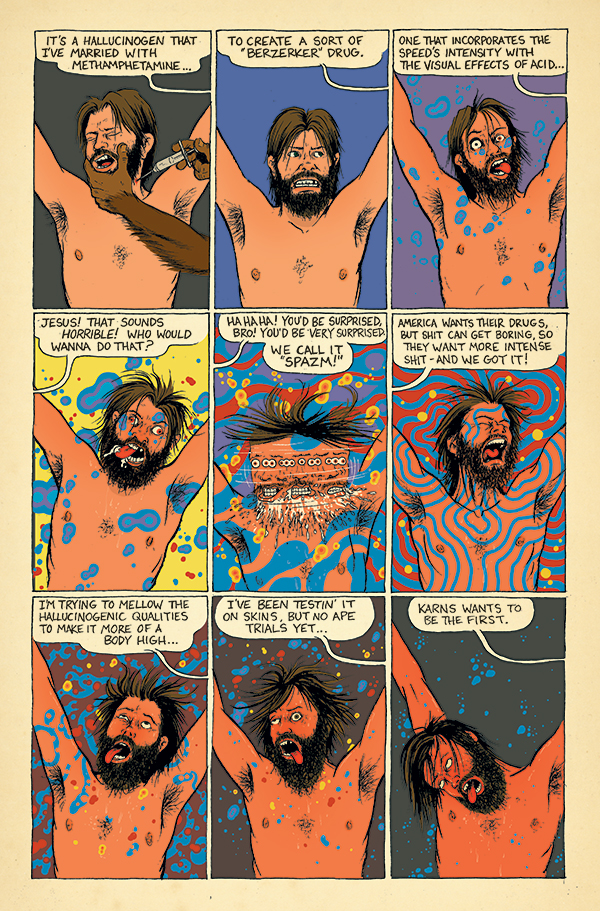 SPURGEON: Keenan, in terms of story, is it fair to say that you're working within the genre as you understand it, rather than deconstructing it or commenting on it? One thing I've heard from other readers is that the story feels more straightforward to them than the execution of that story, that it's almost a standard biker story well-executed more than it is a out-of-left-field treatment.
KELLER: Hmmm... I want The HUMANS to be straightforward in it's aim, visceral in its story telling, while exploiting the medium of the comic book for all its worth. Its bad-ass. Its violent. Its funny. Its harsh. Its wrong. You love it. That's all it needs to be. I like the understated and visceral -- two things that are not mutually exclusive. I feel that the problem with a lot of work in genre (especially in comics) is that everyone IS trying to reinvent or deconstruct the tropes and themes of the genres... The fact is, genres work because they are already deconstructed forms of myth telling. There's too much dialogue filler, heavy handed character and buckets of exposition in everything that is see. Comics all want to be an HBO show... We're not going for that. We wanna make a killer comic!
SPURGEON: One element that certainly doesn't fit in with biker stories as I've encountered them is the slavery thing, with the small-h humans. Can I just ask you in broad fashion what that element in the story means to you? Is that a thought-through metaphor or is that just something you've injected without figuring out what it means just yet.
KELLER: We definitely understand what we're doing with the Skins (human beings) and want the ideas and questions that this might represent in the minds of our readers. But at no time are those ideas more important that the pure exploitative use of them as animals in the comic. They are a lower species in this world and are used as such. I'd rather not define the subtext for the audience. It's more important for them to find that in their themselves.
NEELY: I find peoples' reactions to this very entertaining, actually. It's really difficult for people to see themselves as animals. To me it's very simple -- Primates and monkeys are the dominant species and Homo-sapiens humans are animals. So, we treat the homo-sapiens the same way that we in the real world treat our animals -- as livestock, slaves and pets, for lab-experiments and for entertainment like circuses or "skin-fights" which is the ape-world equivalent of dog-fights. This isn't a "Planet of the Apes" scenario where the apes took over. It's just a simple roll reversal. It makes the world weirder and more fun (or disturbing depending on who you are). And on a personal note -- as a 20+ year herbivore, I find it fun to see the rolls reversed. It makes people squeamish to read it because they're faced with a reality that no meat-eater likes to think about. And I'm having a lot of fun with that.
 SPURGEON: When I was a kid, I thought of all outlaw films as being about teens. I think that's the way we process them for the most part still. That certainly isn't the case here, Bobby is 30, and there are a number of adults around. Was that important to you, to show the reality of these kinds of life choices rather than show it as a passing phase or something people do at a certain point and then leave?
KELLER: Yeah, these aren't teenage delinquents... These aren't kids having fun looking for their place in life... These are real outsiders whom could give two fucks about their place in life. There are mad fuckers on the fringe of society! Deemed by society as outcasts, misfits, losers, no good punks. Apart they are nothing. But together they are The HUMANS!!! This isn't a passing phase for them. They sold out completely to the idea that the world is fucked and ain't getting no better. So, they might as well RAGE against the dying of their rights. They search for pure freedom through hedonism and debauchery. Satan would be proud of them.
NEELY: It may seem like a passing phase or teenage rebellion to "uptights" and "squares," but you can be an outsider from the world at any age -- I know I have always felt that way. I'm an artist. I don't live my life like normal people and I don't value the same things. When I think of Outlaws I think of cowboys, bikers, pirates, gangsters, and so on... But also artists, musicians, poets, punks, pornstars and anyone else who doesn't fit in and carves their own path or lives "off the grid" in some way. It's more than "outlaw" in the criminal sense to me -- it's more about living a different life than the norm. That's at the heart of this story for me.
SPURGEON: Is there something about the way you write the '60s/early '70s -- I imagine neither one of you was born yet -- from your age perspective that is different? Is there something you feel about that time period that hasn't been adequately expressed in other media?
KELLER: I was born in the '70s but I am not a child of the '70s. We both love movies and comics of that time and both were big influences on us as artists and people... There is a romantic side to setting it in the '70s too because it's like a distant memory of a forgotten planet... We've all grown up seeing representations of that time and it's sooo different from today yet similar to the era we are in now... We just wanted to bring a little of the '70s into the comics world with The HUMANS.
NEELY: I was born in '75, so I barely saw the '70s, but somehow that era is more burned in my brain than any other. There is a romantic affinity for that decade as one of the last eras in America when you could be truly "free." It was a time when rock stars roamed the earth like Gods, independent movies had their hay-day in the grindhouse theaters, social change and the beginning of many of the revolutions that we're still fighting were just beginning, heavy metal and punk and funk and the early forms of hip-hop were born, and even regular people experimented in hedonistic activities like drugs, group sex and going to see the latest art-house porn movie. There was still the last bits of the old West permeating the culture. I'm not saying things were "better back then." There was a lot of bullshit. I love the present, actually -- Now is awesome. Now can be better. But now our world is programmed by corporations, and Art isn't even tertiary to technology and money... I don't live in nostalgia but I love the romantic idea that we lost something important from the '70s and exploring it through this comic is trying to bring a little of that back.
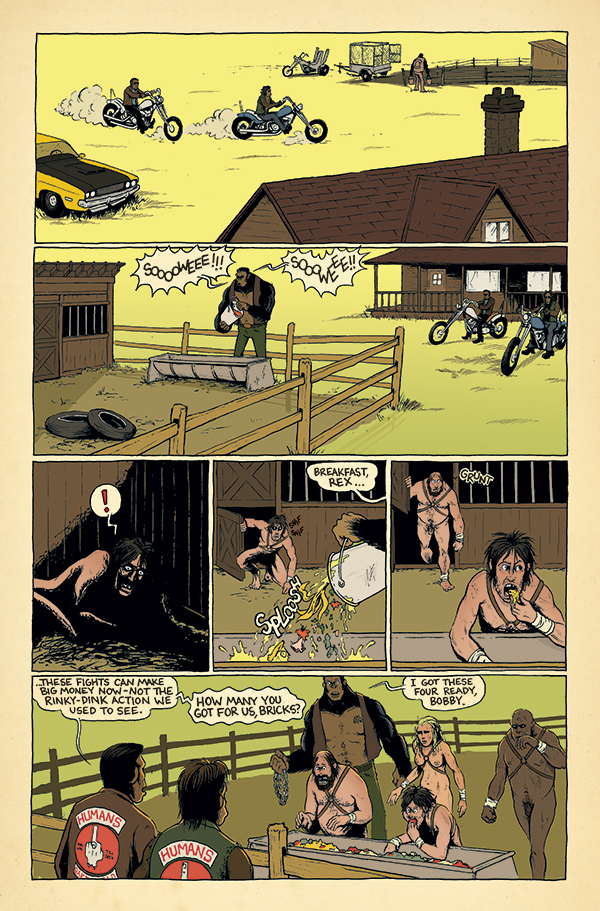 SPURGEON: Tom, your artwork here is interesting in the book because like a lot of comics artists with a single-images background there are moment that are just stop and stare funny, but at the same time, there's a lot of kinetic movement here. How natural is that shift for you? Do you still want to emphasize these specfic moments, is that fun for you? Is that why there are so many double-page spreads.
NEELY: I've largely left the idea of pursuing fine art and painting behind me as comics have become the full focus of my creative energies. The transition has been pretty normal and it's a relief to stop thinking about galleries. The biggest transition for me was switching to drawing comics all day every day to meet a monthly schedule. Doing a book in real time where a book hits the shops only months after I've drawn them, rather than brooding over an artsy graphic novel for years in seclusion are two very different processes. But I also see a lot of similarity in the way I approach pages and breakdowns throughout all of my work.
If you look at my first book
The Blot, I think it has a very similar way of pacing, timed out through different kinds of page layouts -- often building to a crescendo of a full splash-page or double-page spread. When I worked on Popeye with Roger Langridge, I learned from his scripts the importance of ending pages on a beat to keep the reader going -- in comedy this works with punchlines, in action or other comics it's about keeping the energy moving forward. When I'm penciling a comic, I'm thinking about timing constantly -- like I have a soundtrack in my head and I want every page to have a rhythm that carries you through. When laying out pages, I tend to work on two-pages at a time, so I'm always thinking about how the reader sees two pages laying next to each other when it's printed, and when they turn the page for a big reveal that propels them to the next... And yes, I do really enjoy moments where I get to tell a lot of story with one single image. It goes back to my love of painting -- especially the lost art of narrative painting. There have been moments in Keenan's script that just beg for it -- like the scene of the party aftermath in issue #3. The boot camp scene that Keenan wrote for #2 would have taken me 8-10 pages to draw as it was written, so it became necessary to turn it into a two-page montage. Or the psychedelic freak-out scenes that give me a lot of room to experiment. I'm always up for a new challenge and pushing myself to do something different and this book has given me plenty of room to spread out and experiment.
SPURGEON: This is really violent work, and the women characters are maybe not as well-developed in their individual agency as the male characters. Has there been any blowback. It seems like an interesting time to create work that kind of slame up against unsympathetic portrayals of any kind. How do you guys see the mood of comics?
KELLER: I don't see the women as under developed... They might not be the focus of our story as of yet, but they play a strong role in the world. As for blowback, we've actually gotten mostly gotten a great response so far. A couple of people were "upset" by seeing an ape cock and some idiot retailers but the comic in the kids section because it had apes on it, then got mad when parents complained, but over-all lots of ladies have come to us saying how much they love the comic. I'd say we're are giving the finger to the world of PC, uber-sensitive, pricks whom want to legislate and censor ideas cause they don't like 'em. I couldn't give any less of a shit if we "offend" people like that. We want to bring some of the underground's filth and fury to a more mainstream world. If sex, drugs and violence scare you then why the fuck are you looking at our comic?!
NEELY: The mood of comics now is very "safe" and overly PC-policed to the point that most artists engage in heavy self censorship. And I think we're both bored with that nonsense. I also think the current cultural climate is constantly looking for things to be offended by. I try to keep myself away from that aspect of the internet because it is a waste of my time. The only blowback I've heard was about the ape-blowjob in issue #1! Fanboys and nerds are afraid of their penises for some reason. But our fan base is very diverse and includes a lot of women, and other sexes, so I don't think we're doing anything offensive. This is the most diverse audience I ever experienced in the alt-comix scene -- both racially and sexually. One friend told me the skin-fights were as good as gay porn! We have some fans demanding "more ape dicks" and "more violence" so we're finding the right audience. Fans popping up all over the world of every nationality. And I think we all wanna see more of our Ape-Mamas and Old Ladies!
As for a perceived lack of development in the female characters, couldn't you say that about every character other than Bobby or Johnny? Why isn't Chief Rugg more well developed? What about that snow-monkey standing behind Abe? His name is Issei and he has a whole back story, too. This story is about Johnny. You don't necessarily get backstories spelled out to you for every character -- But for what they lack in dialogue, I'm trying to give them plenty of character development in their design and visual portrayal. Believe me all of these ladies -- all of the characters -- are fully realized in my notes and designs. They have distinct personalities, individual styles and diverse body types and different kinds of apes, too. Most of the characters are based loosely on friends, some of whom have modeled for me. Hell, the Skabbs have a badass woman named She-Bitch who is modeled after our colorist Kristina. If we were doing anything offensive to women, Kristina would be the first one to slap us on the back of the head.
But overall, people just need to relax. It's a work of fiction. It's about apes and bikers. You're gonna see some stuff that you don't like. But it's just drawings on a page. It's a comic book. It's entertainment. Hopefully you're laughing with us at the violence.
SPURGEON: It looks like with that last story, the skin fight story, that you're prepared to settle in for a while. How much of this material can you do? How dependent are you on market realities for continuing forward.
KELLER: The Humans is planned as a 9 issue series (+ issue 0), so I don't think the market will affect that, but we hope to continue the story with several more story arcs to come.
NEELY: Yeah, we have planned the stories out into four major story arcs released as mini-series or "seasons." Beyond that, we have lots of ideas for one-offs, side stories and more. But it all depends on how well this first series goes. We wanna keep going and expand this universe as long as we're having fun with it and can make it happen.
 SPURGEON: Tom, has riding helped in terms of depicting it on the page. Is there something specific you can point that you do differently for your experiences?
NEELY: Yeah -- definitely! I've learned a lot that has informed what I'm doing with the book -- from learning more about motorcycle anatomy to improve on my bike designs, to just the feel of the ride that I want to portray in the book. I see other comics that get so many motorcycle things wrong and it's just obvious the artist has never been on a bike. I wouldn't claim to be a "biker," and I'm not a gearhead at all -- most real bikers would probably call me a hipster poseur or a weekend warrior -- I don't pretend to be anything like our characters, but I do love to ride and I needed that knowledge to be able to pull off this book more accurately.
SPURGEON: I saw you both at CALA -- do you think of there being an LA comics scene? Where do you guys fit in?
KELLER: Hahahaha... Good question.
I don't really fit in with the "L.A. scene". There are some cool and nice cartoonists out here but i just don't see or hang with any of them often, other than Tom. Most of my comic friends live far away... I wouldn't have even gotten in to CALA without Tom. i got turned down for a table. So I'm a square peg.
NEELY: Hahaha... on the flip-side, LA Art Book Fair always rejects me, but gives Keenan a table. So, we've become a two-headed monster that will keep crashing your festivals! Where do we fit in? Have I ever? I have no idea. But I think the scene here is thriving and it's really diverse and I'm really happy to see that. There are so many cartoonists moving here to work at the animation studios now, it's amazing! But we're all so spread out and busy working on all sorts of stuff that it doesn't always feel like a "scene." My "scene" includes all kinds of people -- cartoonists, artists, musicians, models, metal-heads, punks, bikers, writers and other assorted weirdos. People think of LA as all Hollywood bullshit, but I love that LA has such a thriving artistic community all around and since it's one of the last big affordable cities where you can conceivably make it as an artist, it seems like that's growing.
*****
*
The Humans Vol. 1, Keenan Marshall Keller And Tom Neely, Image Comics, Softcover, 144 pages, 9781632152596, March 2015, $9.99.
*****
* images from
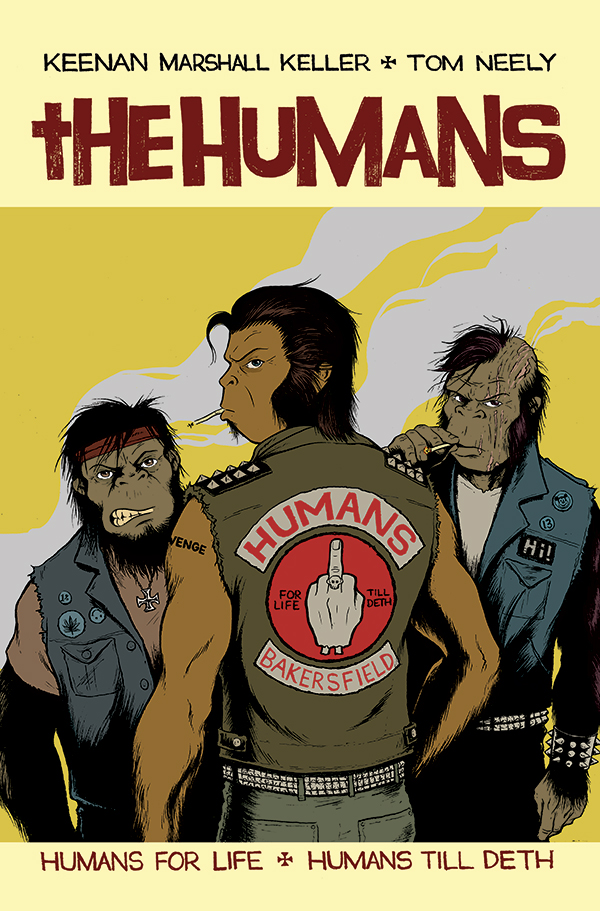
The Humans provided by Tom Neely -- I did my best to find context, but, um, I hope I'm not graded at St. Peter's Gate on that basis. Note that the series' colorist Kristina Collantes did one of the images. One of the thing this series has done -- and a number of Image series have done -- involves the artist's or artists' friends and professional peers contributing pieces using the home team's iconography in pin-ups and back covers. Beyond that, Collantes' contribution is of course regularly key to the look and feel of the series.
*****
*****
*****
posted 10:00 pm PST |
Permalink
Daily Blog Archives
November 2019
October 2019
September 2019
August 2019
July 2019
Full Archives