September 11, 2008
Does A Revitalized Chicago Bode Well For Continued Comics Growth?
 By Tom Spurgeon
As suggested in a couple of previous postings, I spent a day or two in
Chicago this month on either end of a longer trip. I lived in Chicago in the early 1990s, and my brother, Whit, an occasional contributor to this site, has lived there ever since.
In hindsight, I can see that a small but significant part of my time in Chicago was spent making the transition from a comics fan into a comics reader. I hit graduate school and its enforced personal poverty at about the time that one could go to the comics shop on any given week and -- with some latitude to include a
Vertigo title here and there, and maybe
Cerebus -- walk out with one or two non-superhero periodical comic books of decent to high quality. Thus for the first time in my life the comics I wanted cost exactly as much money as I had to spend. I wasn't buying a big ol' pile of four-color fun for a weekly fantasy wallow, and I wasn't pining for an experience I couldn't have. I was buying specific books and individual creators at the point of their release. The weekly trips to either Moondog's or (usually) Halley's Comix proved to be welcome alone time away from class in
Evanston. Those trips became a part of a wider arts experience in the same way that taking a cab to the
Lincoln Center in New York can be part of a night of theatre. I had become a patron of the comic book shop rather than its booster.
Comics seemed around Chicago a lot back then, at least more than I had been used to anywhere else and certainly more than in the small Virginia town where I studied as an undergraduate. I had gone from a washed-out comics Kansas to a full-blown, four-color Oz. I was buying everything I wanted from first-rank comics shops instead of struggling to find one or two things off of a spinner rack.
Chris Ware had just started in
New City; the
Reader still ran its old-school alt-comics and a few scattered pieces by people like
Heather McAdams. There were conventions and occasional gallery openings -- I once sold beer to art patrons mulling around among paintings by
Mitch O'Connell. Special events could be fun as far as they went. I hit the Chicago convention a couple of times. I met
Robert Crumb at a mid-year show out by the same Chicago airport, a strangely alternatives-forward show where I bought comics from Larry Reid at the
Fantagraphics table and
Denis Kitchen at the
KSP set-up. Comics were a part of my weekly immersion in the arts the same way monthly openings at the World Tattoo were, or
John Woo movies at the
Music Box had become or plays at
Prop Theater or any of the other experiences I was having. It wasn't all-comics, all the time; it was great comics given their time.
(I don't know that there's anything meaningful to it, but I was blissfully unaware of anything about the industry's politics during this entire period.
The Comics Journal was too expensive for my meager budget considering what I perceived to be a slight step down in quality from the magazine's Golden era which at that point I marked from the Kirby controversy through
Gary Groth's run of huge, masterful interviews with giants like
Jules Feiffer, Crumb and
Los Bros Hernandez. My perception of what was going on in comics was gleaned from rare comic shop conversations and what was happening on the stands – like I didn't knew who Andrew Rev was, but it was clear something was up with
Comico. Looking back, I wonder if my relationship to comics wasn't just as meaningful for that ignorance.)
I've been going back to Chicago ever since to visit my brother or, from the time he retired until he passed away, to do things with my father. My dad dropped me off at the old
Quimby's location on his way back to Indiana once; my brother and I hit the present
Chicago Comics location for the first time after I left graduate school. I went to a couple of Chicago comics shows while working in Seattle. Conventions and proto-comics stores were how I primarily experienced Chicago as a comics town when I was a kid, so this felt more like a connection to that time than my post-college years. My memory of the 1990s Chicago shows is meeting a few people for the first time while there (like
Grass Green,
Evan Dorkin,
Sarah Dyer,
Dean Haspiel and
Josh Neufeld),
Hart Fisher cursing really loudly,
Steven Hughes' striking presence in that long line of twenty-something kids with long hair with whom he was signing books, having maybe the strangest lunch ever with Susan Alston and Al Simmons, and I swear talking about European comics with
Rob Liefeld's wife. I haven't been back to a Chicago convention since the first Wizard effort, which was more of a mulligan before they really went to work on the place. Over the years, Moondog's closed, Halley's closed, even Larry's on Devon -- a formidable and idiosyncratically run old-school shop to which hundreds of kids all over the Midwest made a destination trip at some point in their young lives; imagine
Willie Wonka's Chocolate Factory if there were no hope for ownership and Wonka were played by
Harry Dean Stanton -- closed.
Dan Clowes, who once wrote one perfect Chicago strip after another, moved west. The University of Chicago produced at least two cartoonists of note:
Ivan Brunetti and
Jessica Abel. Chris Ware moved papers and then moved papers. Chicago Comics walked up the street a few blocks, lost an Eric and purchased Quimby's.
The point to all of this is that with my brother moving to Los Angeles, that very well may have been my last time spending several non-vacation regular workdays in Chicago, or maybe any significant time at all. So I wanted to say thank you to the wider comics community and retail landscape that helped me streamline my passion for comics into the wider interests of an adult, arts-interested life. I also wanted to point out that while spending an inordinate amount of time this trip hitting comic book shops and seeing cartoons everywhere -- walking around town became my default exercise activity -- it seemed to me that Chicago as a comics town is in the midst of a comeback. Chris Ware is as esteemed as any local writer or artist. People love
Alex Ross, too, in a distanced but respectful way that reminds me of how people used to speak of
Chester Gould living and working nearby. I saw one comic book store opened up a short walk from the location of Larry's long-gone hole in the wall, with stock that would have made it one of the three greatest shops I had ever visited if I had seen it back in 1991, and saw signs of another shop from a successful chain reportedly about to open just a bit further away. I heard about a shop opening near
Arturo's over by Damen and Western and Milwaukee that sounded like it was making a minor religion of hand-selling. I shopped several times at a consistently high-performing Chicago Comics store, Jordan in '93, and thought briefly each visit about purchasing their shrink-wrapped block of every single issue of
Walt Simonson's
Thor run. I bought a Sunday
Sun-Times in addition to a
Tribune for the first time ever because
Cul De Sac runs in the
Sun-Times. Someone on the El that saw me reading some editorial cartoons boasted that they used to work with
Bill Mauldin. I saw a
Hairy Who presentation in the Art Institute's library with more than a few
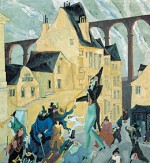
Dan Nadel notations and laughed at the two R. Crumbs the museum space had hanging near a George Grosz in one of the I think permanent exhibits, about two hundred yards from a massive painting by
Lyonel Feininger.

That's not to say everything seemed healthy. The Tribune's Sunday comics section was printing their features the smallest I'd ever seen in a major newspaper. There's still no real equivalent to Moondog's, that high-end chain in a prime downtown retail locations (
Graham Crackers comes closest), at least none that I saw (the Moondog's location I used to visit was house one of the city's many pizza joints named Ranalli's). I found excuses not to visit Quimby's, which has happened more often than not the last few times I've been to the Windy City and can't be a good thing for a store like that. The
Borders locations I visited look like sick relatives putting on a brave face during Thanksgiving holiday, with fewer comics and less vigorous presentation, at least to my eye. Overall, though, it seemed that people in Chicago were interested in buying and looking at and even occasionally talking about comics in a way I don't think was true during any other visit I'd made in the last 15 years. It was a good comics trip.
As a result of all this good will and multiple, near-daily opportunity, I bought more comic books in two weeks than I had the last two years, enjoying the thrill of stepping into a shop and spending a few dollars and taking some sort of comic book home. I'm more convinced than ever that comics retail is there to create business as much as facilitate what's already there, and I hope that efforts to open more stores in the months ahead proceed cautiously and vigorously. Having lived five years in a town without a comic book store, I find it incredibly easy to be seduced by them. Chicago isn't New York or Los Angeles when it comes to being a comics town, but I think it's more representative of the country between the coasts than any other city west of Jersey and east of Palm Desert. A resurgent Chicago, the greatest arts city in the world in terms of its audience not being a busload of tourists or a motley collection of friends and family members, would have to be a good sign of comics' immediate future. One only hopes the major players don't eventually kick over the lamp.
posted 8:10 am PST |
Permalink
Daily Blog Archives
November 2019
October 2019
September 2019
August 2019
July 2019
Full Archives