February 4, 2008
Gus Arriola, 1917-2008
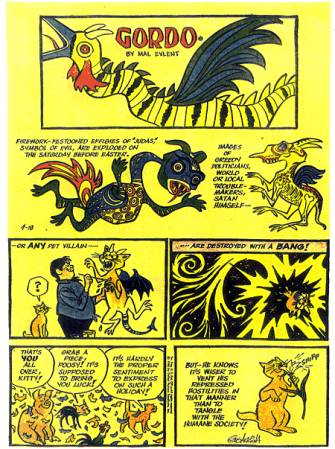 Gus Arriola
, the enormously well-respected cartoonist behind the long-running
Gordo and by virtue of his own ethnic background and the Mexican setting of his strip one of the 20th Century's leading lights of Hispanic culture,
passed away on Saturday at his home in Carmel, California after a long battle with Parkinson's disease. He was 90 years old.
Arriola was born in Florence, Arizona, approximately two hours from the Mexican-American border. His father had been born in Mexico and imparted knowledge of that country's culture to his nine children. The Arriolas moved to Los Angeles when their youngest child was eight years old, which gave a teenaged Arriola access to the Mintz and MGM animation studios where he learned and applied his craft.

Arriola sold
Gordo to United Features in 1941, converting an existing cartoon bandit design into the bean farming, not-so-bright protagonist. Several of the obituaries mention that Arriola slimmed Gordo up, changed his accent and became somewhat smarter in part due to criticism about the potential stereotypical nature of the character. At its height,
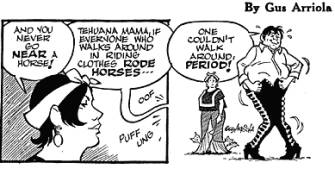
Gordo was in 220 newspapers, making it a solid performer but never a hit. In the early 1960s, Arriola changed the strip from a story strip into more of a gag feature, started to place an even greater emphasis on Mexican and Mexican-American culture than before, and began to create done-in-one Sundays with impressive design qualities. It is that two- to three-decade run by which Arriola made his reputation not only with a general readership lucky enough to have
Gordo in their papers but with comics fans and fellow professionals.
Longtime Arriola friend RC Harvey,
who wrote 2000's Accidental Ambassador Gordo: The Comic Strip Art of Gus Arriola, described Arriola's career arc thusly:
Cartoonists generally would agree with Malcolm Whyte, founder of the San Francisco Museum of Comic Art, who just yesterday told Wyatt Buchanan at the San Francisco Chronicle that "Arriola's Sunday strips were a tour de force of rich, vibrant color, lovely line work and dazzling artwork -- stunning pieces of art." And all of that is true. But what is seldom realized is how gifted a storyteller Arriola was.
Most of his reputation rests on the "design quality" of the strip since about 1960. About then, Gus stopped telling stories from day-to-day and would go for weeks supplying a gag-a-day. That's what most people remember. He ran continuities occasionally, interrupting the daily jokes, but before 1960, the strip was a thorough-going storytelling strip, week after week, month after month, year after year; and Arriola's plots were stunningly complex, tiny details contributing to their tangled skeins. And many of the details were entirely pictorial, little insights into personality conveyed with body language, say.
That admiration for Arriola's work is shared even by today's cartoonists, decades after
Gordo ended.
Mark Tatulli of Lio told
CR on Arriola's passing, "A sad day for cartoonist's everywhere. A unique voice and a great pen has been silenced." He added "I remember seeing a Gus Arriola original Sunday strip. Huge by today's standards. Lots of detail and beautiful illustration... more like a painting than a comic strip... but I was struck most by there was not one single mistake on the whole page. Nothing patched with bits of paper or white cover-up. Amazing. I remember thinking, 'Now here's a cartoonist with confidence.' Would that I could have that kind of confidence."
 Gordo
Gordo continued until 1985 when in the traditional ending for a comedy there was a marriage between Gordo and housekeeper Tehauna Mama. Like many long-running strip,
Gordo was informed by elements of its creator's life, which found particular voice in the lead character. This may have been most noticeable in the relationship between Gordo and nephew Pepito, which
the San Francisco Chronicle obituary I think rightly points could be compared to Arriola's relationship with his son, Carlin. After Carlin died in 1980, Pepito's last appearance was in the final cartoon as a tape recorded voice.
Harvey says that Arriola spent much of his time retirement drawing for local charities and was social with cartoonist friends in the area like the late
Hank Ketcham and the late
Eldon Dedini. He also participated in securing his own legacy. Arriola assembled books of
Gordo strips, two of which were published. The publication of
Accidental Ambassador also threw a spotlight on the cartoonist's accomplishments. "We became good friends," Harvey told
CR. I sent him copies of my bi-weekly website effusions and phoned him every couple months. And I always stopped in Carmel for a day to visit him and his wife Frances on my way back from the San Diego Comic-Con every summer. Much to my surprise, my book brought him a certain recognition that had somehow passed him by until then -- or so I judge from comments he made, expressing delight and appreciation at not being entirely forgotten. And I think he felt my book revived people's memories."
No matter if people came to
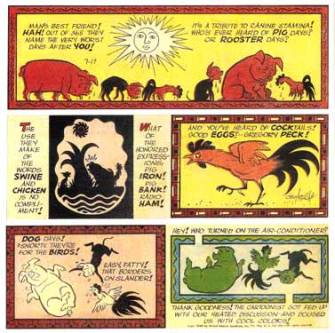
Gordo for the first time or in a subsequent visit to a feature carried by a local paper in their circle of influence, what many fans saw is a well-designed, sturdy and amusing strip with frequently stunning Sundays on a level with very few in the second half of the 20th Century, and unmatched in their versatility. One such person who came late to Arriola's work was the cartoonist and comics commentator Mike Lynch, who immediately
saw their value. "The cartoonist had a wonderful command of design, and light and dark. A gentle wit, a true cartoonist, a guy who made it all look easy." Scott Saavedra
recalls the cartoonist having an almost regal bearing, but "swung a brush like nobody's business." In
analyzing a few of Arriola's Sundays, the cartoonist Brian Fies remembers, "The strip had swell characters and an easy-going charm, but what really caught my eye was the way Mr. Arriola played with the language and iconography of comics in ways I'd never seen before. His use of graphics was masterful."
It's my memory that in recent years work by Arriola also began to be included in comics art shows, which would surely add to his legacy. In 2006 UC-Berkeley's Bancroft Library acquired the
Gordo collection from the cartoonist. A reception honoring the collection is still scheduled for March, although without the cartoonist in attendance.
Says Harvey: "I'll miss the sound of his voice on the phone (we're both hard-of-hearing, so we shouted at each other a lot), his wit, his appreciation of artistry in cartooning -- in Dedini, in Ketcham -- and elsewhere -- in the illustrations of another friend,
Al Parker. In writing my book about
Milton Caniff, I "lived" closer to Caniff than I did to Gus: I phoned Caniff more often with questions and so forth. But I'll miss Gus more."
Gus Arriola is survived by a wife of 65 years, Mary Frances, at his side as he passed away.
 posted 9:15 am PST
 |
Permalink
Daily Blog Archives
November 2019
October 2019
September 2019
August 2019
July 2019
Full Archives