April 25, 2008
R. Crumb’s Underground Closing At Frye
 By Tom Spurgeon
This week marks the last few days of a long run for
R. Crumb's Underground at the Frye Museum in Seattle, Washington. The Frye is one of the Emerald City's hidden treasures: an old-fashioned neighborhood museum of national stature just far enough from the city's downtown to draw people into a different part of that great Pacific Northwest metropolis, its town-like neighborhoods on tops of hills and at the center of valleys. The Frye is a comics-friendly place as well, frequently hosting not only visual artists whose series carry within them a narrative component but also serving as the Northwest stop for one of the better exhibits in the comics-are-ignored era from a decade or so back: a fine
RC Harvey-coordinated exhibit of strip art that I visited when I lived in Seattle. Recently, the museum has hosted a number of programs related to the Crumb exhibit with local cartoonists like
Greg Stump and David Lasky.

I believe this is the second stop for the
Todd Hignite-curated exhibit, which looks like it was drawn primarily from two or three major Crumb art collections and supplemented from commercial suppliers and museum holdings when necessary. I haven't heard of a third stop, at least not yet. That's too bad, as it's a fine afternoon at the museum, about as good as it gets in that realm for comics. R Crumb Underground features a well-selected grouping of pages and illustrations that's solicitous towards several phases of Crumb's career, some well-known and some that one day should be. A patron new to Crumb's work will see many of his career highlights and prodigious displays of craft; someone fond of his '60s humor will see a lot of those comics and the more traditionally serious work that came after; Crumb fiends will get a few works that don't get discussed very often and a few obscure sketchbook images. There were pieces from a pen and ink series from the last decade I'd never seen before and one or two underground-era samples of art I'd only ever looked at once or twice.
One of the great things about Crumb's career that's facilitated in this show is how his prolific nature provides what might be a period of one or two works for another artist with the weight of an entire movement within Crumb's greater career arc. In that light, I greatly enjoyed a few illustration-style studies from the early 1970s, when Crumb's work was stripped of some of its more cartoon-like components but hadn't developed into the astonishing '80s style with its thick lines and dramatic shading. I can imagine a future where mini-moments in Crumb's lifetime output fall in and out of favor, at least among the hardcore fans that will still undoubtedly follow his work.
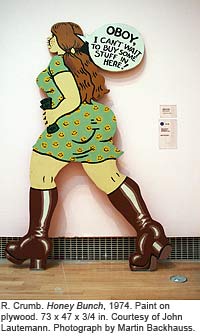
Oddly, one of the great things about most comics art shows, especially those that feature older work, is almost entirely absent from R. Crumb Underground. There was almost no opportunity to note non-reproducible craft elements and changes in the original art. In fact, I was kind of baffled by some of the changes for which it was hard to discern on what basis an alteration was made: a door in the Charley Patton story, for instance, that looks like it was moved within the frame a bit; a tantalizing paste over on some text from one of the '60s back covers. In general, this may be the best comics show I've seen where I can't come close to being able to articulate what was astonishing or enlightening about seeing the originals. It's funny: I read almost all the original art in R. Crumb Underground as comics far before -- or in lieu of -- scanning the pieces as illustration or component art. Usually the opposite is true.
It's almost always great comics and illustration, that's for sure. Comics in general have that rare ability to make you nostalgic for things that don't exist, or to make you pine for things that already do. Crumb is well-reprinted, but the unadorned pages from comics and things like covers for the
East Village Other made me desire the originals, the way that Crumb's art would hold the cheap inks and the whole project suggested something seedy and subversive made profound by the cartoonist's craft chops. I never thought I would go to Crumb for confirmation of a pet theory that the comic book format is undervalued, because so much of his life's work stands apart from its original object status. But I defy folks to go to this show and not come out of there just as desirous of a giant box of moldy underground newsprint as they are for a pristine set of
Complete Crumb hardcovers. I was also fascinated by a film that was running that since I didn't see it was available until I was heading out the door lack context in explaining to you. It was essentially a home movie of the underground cartoonists interacting with Harvey Kurtzman. It's funny for Kurtzman's shtick in dealing with the excessive material being placed in front of him, and fascinating for the cartoonists' attempts to elaborate on their relationship with the material. Probably everyone knows all about this film but me.
Crumb is I think the world's greatest living cartoonist for the consistency of his career output, his contribution to the comics art form in raising the sketchbook to the heights of any controlled graphic narrative, his historical impact and effect on other cartoonists, and what this exhibit quietly celebrates -- his status as a cartoonist whose individual works are relatively unknown while at the same time his general approach to art has cultural currency to the point that nearly everyone can share in a celebration of his life's work.
 posted 9:00 am PST
 |
Permalink
Daily Blog Archives
November 2019
October 2019
September 2019
August 2019
July 2019
Full Archives