| |
 |
| Tom Spurgeon's
Web site of comics news, reviews, interviews and commentary |
|
|
|
|
|
|


May 10, 2010
Random Comics News Story Round-Up
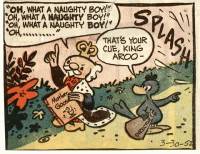
* been cleaning out the mailbox this weekend, and found a number of letters on various comics issues of recent vintage. To kick things off, here's what Nat Gertler wrote in response to the fact that despite having more great comics stores, fewer serial alternative or art comic books are being sold. "For one thing, there is now more competition for slots in that store... just not from pamphlets. The creator working in the traditional American comic book format is not only competing for space with Crumb's Genesis and whatever First Second is putting out this month, but with almost every worthwhile work ever. The availability of offbeat material like the classic King Aroo or the works of Fletcher Hanks, or the easy availability of the full outputs of the brothers Hernandez and Chris Ware (well, minus Floyd Farland), with new oldies being uncovered all the time, just floods the market, and those things have some degree of recognizability that a new book by a new creator does not enjoy.
 "For another thing, the start-up barrier is higher. No longer can you put out a black-and-white comic, cover your print costs with sales of a thousand copies, and hope to build your audience while re-offering your early issues. Sales like that won't meet the current Diamond minimums. So you go to color, for the added sales, but the expense of doing so means that the additional sales may not cover additional costs." "For another thing, the start-up barrier is higher. No longer can you put out a black-and-white comic, cover your print costs with sales of a thousand copies, and hope to build your audience while re-offering your early issues. Sales like that won't meet the current Diamond minimums. So you go to color, for the added sales, but the expense of doing so means that the additional sales may not cover additional costs."
"But perhaps the toughest thing at the moment is the level of noise in the industry. There are so many projects trying to get attention, and the big two have gotten much better at maximizing the number of articles gotten out of a single issue (look, it's the unveiling of the cover! the unveiling of the variant edition cover! the issue-specific interview with the writer!). To use Phonogram as an example -- here's a series that was around for years, that I saw in local comic shops, yet I cannot recall seeing a single article about it. I'm sure such articles are out there, but they get lost in the sea of comics coverage. It used to be you'd see material about William Mesnner-Loebs's Journey in all the major outlets, back when the major outlets were all print. Now, it's harder for such a project to peek through." Those are all good points. I disagree with most of it, although that's an article for another time. My strongest objection would come to the third part of Nat's analysis. I think there is more coverage of more projects than ever before. Google shows plenty of articles with Phonogram as their focus, and my memory is that it had a ton more coverage than what would have been available to Journey back in the day. Are there more comics? Maybe, although there were a heck of lot of comics back then, too. It's hard for me to imagine anyone great that started doing comics that wouldn't be discussed in a dozen places as soon as they were discovered. In fact, you could almost argue that the best '80s comics are better covered by today's framework than they were back then.
* here's Gabriel Roth on the same issue:  "You wondered about this in your post on the Kieron Gillen interview, and it surprised me that you don't mention what seems to me the most economically straightforward answer. The number of boutique comic stores has increased, but the number of comics and related products appealing to alt-comics fans has increased more. In 1996, every single member of the alt-comics demo was buying Hate, Eightball, L&R, and Acme Novelty Library. It went pretty much without saying that those were the best and most important comics. Nowadays, my art-comics dollar could go to books from Ware or Clowes or Los Bros or any of a jillion other cartoonists making serious non-superhero work, or to full-size reproductions of Little Nemo or reprints of just about any other well-regarded strip in history, or to Kramer's Ergot 7, or ... You get my point. Demand is up some, but supply is up a lot." "You wondered about this in your post on the Kieron Gillen interview, and it surprised me that you don't mention what seems to me the most economically straightforward answer. The number of boutique comic stores has increased, but the number of comics and related products appealing to alt-comics fans has increased more. In 1996, every single member of the alt-comics demo was buying Hate, Eightball, L&R, and Acme Novelty Library. It went pretty much without saying that those were the best and most important comics. Nowadays, my art-comics dollar could go to books from Ware or Clowes or Los Bros or any of a jillion other cartoonists making serious non-superhero work, or to full-size reproductions of Little Nemo or reprints of just about any other well-regarded strip in history, or to Kramer's Ergot 7, or ... You get my point. Demand is up some, but supply is up a lot."
Again, I think that's a good point, although I think there were a fair number of comics to buy back then, too. I would also imagine that for the generation of consumers buying comics in 1994 and in 2010 that the ability to buy more comics has improved as well. But it's only this one specific area of comics that seems to have shriveled up.
* here's a letter I totally missed the first time around from Sebastian Oehler of Reprodukt talking about how graphic novels are sold in the little talked-about German market: Just wanted to add some information to selling Graphic Novels in Germany.
 Starting in the '80s lots of regular bookshops started to shelve comics, mostly Franco-Belgian material. The Franco-Belgian market collapsed end of the '80s and the comic pamphlet hype end of the '90s and beginning '00s wasn't supported by most bookstores so comics were not that present in lots of bookstores in the last couple of years. This is about to change as the important newspapers started to write about comics and Graphic Novels and there are many books published right now that don't focus on the regular comic shop guy. Starting in the '80s lots of regular bookshops started to shelve comics, mostly Franco-Belgian material. The Franco-Belgian market collapsed end of the '80s and the comic pamphlet hype end of the '90s and beginning '00s wasn't supported by most bookstores so comics were not that present in lots of bookstores in the last couple of years. This is about to change as the important newspapers started to write about comics and Graphic Novels and there are many books published right now that don't focus on the regular comic shop guy.
Last year we had a Graphic Novel presentation in a huge bookshop in Frankfurt and they presented more than 150 different titles.
We also created a Graphic Novel flyer to promote Graphic Novels. The first two editions were drawn by Sascha Hommer and the current edition is drawn by Kati Rickenbach, a young artist from Switzerland and with the third edition we have a combined print run of more than 100,000.
You can download the first version here.
And the current version here. Yeah, I knew almost none of that.
* here's an Alan Grant interview I missed despite being e-mailed about it. Ditto one with Kevin Rechin. I still occasionally get e-mail about comics-related statues, like this note about a terrifying Steve Canyon.
* did I forget to congratulate Paul and Stacey Sloboda on the birth of Ian James? Probably.
* from David Brothers came a note about a snarky comment I made on how well comics bloggers claim to know their audiences. He wrote: And this is almost exactly a week late, but in this post you wondered how online talking heads know their audience so well. My site backend lets me see stats on specific posts, so I can tell that (for example) Gavin's This Week In Panels ongoing feature always does X number on Sunday, then X-200 on Monday, and trending downward until it hits double digits on Wednesday. On the other hand, writing a thousand words about a rap album I like on my comic book blog tends to have a much shorter life, just a day usually.
I can also sort by performance over certain periods of time- a week, a month, 90 days, a year, and all-time. I pay more attention to it than is probably healthy, so I have something of an idea what the audience goes for (lists, image heavy posts, ongoing features, off-the-cuff snark, and mean disses about books/Greg Land), but somehow keep writing what I like (million word essays about books only I like) and things turn out okay somehow. David is right in that I failed to give credence to being able to look and compare and work with back-end statistics, particularly considering I haven't looked at my own since February 2006. There are probably many ways you can process that information. I do remain a bit suspicious that such numbers crunching results in a conversational familiarity with one's audience in the way the panel report seemed to describe, but it's much closer to possible than I allowed. Thanks, David.
posted 3:00 am PST | Permalink
Daily Blog Archives
November 2019
October 2019
September 2019
August 2019
July 2019
Full Archives
|
|
|
|
|
|
|
|