October 27, 2008
The New Comic Foundry: Three Quotes That Grated On Me And One That I Liked
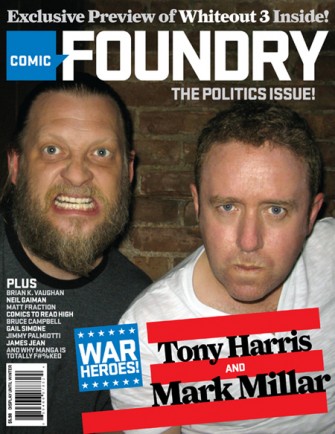
Yesterday was another Sunday morning with no newspaper on my stoop. This never happened when the economy meant paperboys and papergirls delivered it, but it seems to happen every seventh or eighth time now that I rely on a surly guy roaring by in his truck. Without a proper Sunday paper, I grabbed
the new issue of Comic Foundry and climbed back into bed, coffee on the bedside table, nearby windows open to the sounds of morning, for a nice non-start to a lazy, do-nothing, Fall weekend day. Here are some quotes I came across that I remembered to the point I wanted to comment.
"The next person who commiserates with me about comics' falling circulation and says, 'What we need to do is get comics back on the newsstands!' is going to get two in the back of the head, quick and painless." -- Mark Waid, "The Newstand Is Old News," page 23
I agree with Mark Waid more often than I disagree with him on industry issues. That said, who the hell is he talking to that is pushing the newsstand as a solution to anything at this point? I can't imagine this being anybody anyone would take even halfway seriously. I mean, my Mom might do this, or some ancient comics pundit whose interactions on-line are limited to a juno account. Certainly no one I know that works in comics or has more than a passing knowledge of it would.
In general, Waid's short essay on the wonders of the Internet and its possibilities reads like something that was written in 1997 rather than 2008: a wishful, enthusiastic nod to a brighter future just around the corner. The problem: the comics Internet is already here. There are well-known, well-respected companies that could not function without their Internet-based revenue, another group of companies that would function much less effectively, traditional cartoonists galore that make a significant portion of their income via on-line methods, and a brand new wave of self-publishers out there making up to six-figure incomes based around comics enterprises that are only just now starting to find their way into other media. It's not lack of imagination that has kept comics from diving in that much more fully on-line. It certainly isn't adherence to nostalgia, at least not anymore. It's a lack of practical skills all around, institutional sloth in the broadest sense, the fear of maintaining the current infrastructure at the companies that are big enough to have such infrastructures, the fear of maintaining already miniscule profit margins at companies too small to worry about infrastructure, and a dearth of focused capital.
In other words, my impression is that the conversation moved away from the primacy of the newsstand a long, long time ago. A more interesting discussion that sometimes gets floated -- and one that comics' long relationship to the newsstand could inform -- is that companies should go all in on the Internet at the expense of everything else, sometimes phrased as "the X/Y/Z way of doing comics is doomed and everyone needs to make way for the future." I don't think that's necessarily the case, either, and moreover, I think it's a bad thing to pursue that philosophy as policy. Comics people set up either/or situations like they get a royalty for doing so, though, so the industry goes through periods where it embraces new markets believing it's the only one they'll need... until the next one emerges. I think we may be there right now with the Internet and its various avenues. I can't be alone in sensing a potential tipping point. I just hope it isn't tipping over.
My view is that comics should exploit all the markets. There are no hard and fast rules that says one works and the other doesn't. If there were, the newsstands would have been shut down entirely as a market for new comics -- and
Shonen Jump has worked just fine there. I feel that comics should be on-line and everywhere else anyone will have them: on cell phones, in comic shops, in bookstores, and, as many that are still around, spinner racks, too. There's no need to hurry along any delivery system's demise, no reason to shut any one door.
That may seem like an obvious prescription, but as many people as I've read proclaim certain avenues outmoded or even outright wrong in some vague and pernicious fashion I don't think you can ignore the impulse in comics to embrace the next big thing in a way that can leave both sides gasping for air. I think Waid's essay suggests why this strategy appeals: because the next way of delivery is the only thing that can promise a re-ignition of comics' popular medium status. I'd suggest it's that notion, not any specific delivery system, that's outdated. Comics may do extremely well on-line over time just as they've done fine to great in the short term. They may do better than ever before. I'd be surprised if at least some of them don't find that on-line distribution is the best suited system ever made to the specifics of what they do. Still, I can't imagine any scenario by which the delivery of comics on-line matches the success music and video and prose has enjoyed there. The thing is, that shouldn't matter. Our goal can't be to make comics a mass medium when there's so much to do to make it a great art form fueling an ethical industry. It's not as important that everyone not reading a comic read a comic than it is we ensure that the people out there that want them get them. Delivery systems should serve content, not the other way around. For the immediate future, that's a war best fought on all fronts.
updated to say: I've received a small flurry of e-mail saying that the newsstand argument is still a solid part of superhero-centric message board discussions; I did not know this
"Comics guys do have a shelf life." -- Mark Millar, "Millar Time," page 39
Mark Millar's interview in this issue of
CF is fun because 1) it's not like he doesn't have a filter, but his is certainly set up differently than most people's, and 2) he's a guy that's obviously thought through the careerist aspects of comics to such a degree that he's bound to come up with several funny observations and solutions concerning the problems presented. His observations on the callous nature of the comics industry are my favorites here.
As seen in the quote above, one of Millar's more recent shticks is to suggest that the work of everyone in comics older than 45 years old starts to decline. This is typically hilarious of Millar in that it's obviously self-serving. He's not 45, but he's close enough that he can talk of the next round of projects as final, or heading towards some conclusion, even if it's an arbitrary one. Millar's also at the point in his career where he's pitching for assignments or jostling for attention with a lot of writers around this age. That doesn't make it a rule. I think even suggesting it as such can be harmful to comics' long-term health.
First of all, it's not true. It's fair to say that it may be harder to write industry-shaking event comics and high-profile, movie-ready series the older you get and the further you move away from the youth culture that defines the language in which such events traffic. I don't think Joe Simon is going to be tagged to write the next Ultimate Marvel crossover series the same way I can't imagine there are a lot of
Saturday Night Live writers over the age of 70 or that Bruce Jay Friedman will soon become head writer at
The Daily Show. Comics folks at all levels enjoying launching, discovering and celebrating new talent. I think all of us with some interest in comics see the effects of the book industry's fascination with new talent taking shape in which cartoonists are getting which contracts from book publishers. It doesn't take a pop culture savant to figure out that youth is more and more frequently served.
However, if you allow yourself to define comics as something more than its leading edge in terms of monies received and pop culture currency obtained, it's clear that plenty of its creators do extraordinary work over the age of 45. Jack Kirby was older than that for his best period at Marvel Comics, and then went on to the very fruitful Fourth World period that by itself dwarfs the career output of all but handful of mainstream comics creators. The majority of the most popular
MAD cartoonists were older than 45 during its 1970s flush period. Charles Schulz was older than 45 in the late '60s and the early '70s on
Peanuts, its most popular and culturally relevant period. One of the best, most prolific cartoonists of the last five years, Gilbert Hernandez, was older than 45 during that astonishing period. I'd rather have all the Joe Kubert Comics made after he was 45 than the ones he made younger than 45.
Even with these examples and dozens upon dozens of others to go by, it's fair to say comics has done a horrible job of supporting widespread publishing opportunities for older cartoonists, especially in the kinds of comics favored by Millar. That absence of older creators combined with the natural tendency for audiences to put more weight behind material when they first encounter a unique point of view make the creative landscape a rocky place for those who have been around a couple of decades. But it's not for lack of skill, at least not always, and instead of recognizing he may need to leave the field
Logan's Run-style at a certain point, maybe Millar could put more of his advocacy in service of ways for people to keep creating and finding an audience for what might just be great work even if it isn't top of charts or summer blockbuster fodder. I know I'd read a comic book written by a 60-year-old Mark Millar. Why not leave that possibility open?
"One of the things that makes him so good as a writer is that his work appeals to people." -- Karen Berger, "Man Of Your Dreams," page 54
I have nothing bad to say about Karen Berger. She was nice enough to interview with this site last year, she's a much-respected industry veteran, and she seems like a really nice lady. For some reason, however, the writer of
CF's article on the 20-year anniversary of the
Sandman series uses three or four quotes from Berger that don't seem to mean much of anything. I don't blame Berger, and to be fair, she does unpack the thought above a bit in the graph that follows the statement. Additionally, I sympathize. I have a hard time articulating why I like certain work, and a more difficult time than that putting into words how I think about projects I worked on or near that are dear to me. What I don't understand is why both Berger and the usually insightful
and quick on his feet Gaiman weren't pushed for a little more than a recognition of the surface awesomeness of their industry-altering project. And since they weren't pushed, I wonder why the editors didn't send their writer back to do some more work, or if that was impossible, to bring in some other witnesses (like one of the artists, maybe?) to provide missing details. They certainly had the room, given the two-page, content-free and not particularly attractive introduction spread equal to the size of the finished article.

Nitpicking and second-guessing? Probably. I have a reason, though. Beyond my personal taste, focused observation is important to such articles -- and, I'd suggest, to comics history -- in that when not tethered to specifics it's too easy to see
Sandman and books like it in ways we want to see those books rather than for what they are. In this case, I'd argue that
Sandman wasn't a project that succeeded for its novelty but one that hit hard with readers over time because of the skill of its execution. If it was the first of this or the first of that wouldn't have mattered if the comic hadn't been very well done. Sometimes a great comic is a great idea, or a break with a past or an innovative effort. A lot of the time it's also just a really good comic.
Comics tends to overwhelmingly favor the idea because the idea is currency that's a) translatable to other media, b) speaks directly to your ability to do something similar for someone else in the future, and c) codifies the contributions of those on the masthead that may get harder to track as a series progresses. The complicity from those who cover comics in favoring idea over execution is what I would term the Stan Lee effect, where Lee's desire to move into other fields after his success at Marvel in the 1960s created a culture of valuation that gives weight to the portable concept over the less portable work itself. I think if you take a longer look at Gaiman's signature comic series, what you see in Sandman wasn't an idea that hit like a lightning bolt but a well-done, consistent comic book that like a powerful rush of water pulled a bigger and bigger readership into its wake as it continued on. There's a fine line between making the case for a great comic book as a great comic book and making a case for it based on all the ways it isn't a comic book. The way to avoid that line is to deal in specific observation that keeps you honest.
"Under no circumstances, in no lifetime, would I ever acknowledge that guy had any sort of authority, real or imagined in my life." -- Matt Fraction, "Comic-Con Confidential," page 44

Finally, I enjoyed this quote from writer Matt Fraction that came in the midst of a piece drawn by Chip Zdarsky about various pros' con experiences. (I liked that whole feature.) Fraction's anecdote was about he and his friends bailing on a heavy-hitter's party and its doorman (portrayed at right) in order to gather somewhere and shut a bar down with good conversation. I'm way too old and boring and very much not invited to cool parties to make a statement like this one out loud, so it was nice to hear someone who is going to have more and more of those opportunities come their way arrive at that conclusion.
I think it's an attitude comics could use more of. The cross-industry interest in comics across the board is great, but I hope no one forgets the good things about the comics industry in a mad rush to become an adjunct to Hollywood and/or book publishing. That set of values may reveal itself in the absence of some of the extraneous bullshit that surrounds other industries that make and spend more money, it may reveal itself in maintaining our own, distinct system of distribution and reaching fans, it may come out when we write a letter to an editor telling them that an artist also worked on the comic profiled, and should be considered a co-author. If the interests and opportunities that comics will enjoy over the next few years are indeed real, I think that they can be embraced douchebag-free.
posted 8:00 am PST |
Permalink
Daily Blog Archives
November 2019
October 2019
September 2019
August 2019
July 2019
Full Archives